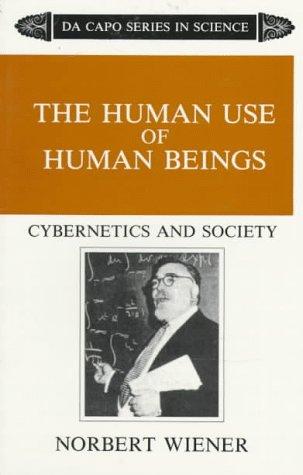
The Human Use Of Human Beings
Norbert Wiener
Explore the foundational principles of cybernetics to understand how the flow of information shapes both biological life and mechanical systems. By examining the ethical crossroads of automation, you will learn why preserving human dignity is the most critical challenge in an increasingly programmed world.
The Universe of Messages
This chapter introduces the fundamental concepts of Cybernetics, contrasting the entropic nature of the universe with the organizing power of information and feedback.
The Fight Against Entropy
Feedback: The Heart of Control
Cybernetics and History
The Human as a Message
Language and Learning
Wiener examines the unique capacity of humans to learn and communicate, distinguishing our flexible intelligence from the rigid structures of insects or early machines.
Learning vs. Instinct
The Mechanism of Language
Language as Social Binding
Translation and Ambiguity
Cybernetics in Society
This section applies cybernetic theory to social structures, including law, secrecy, and the ethics of scientific responsibility.
Law as a Communication Process
The Pathology of Secrecy
The Market of Ideas
Ethics of the Scientist
The Second Industrial Revolution
Wiener explores the transition from manual labor automation to the automation of mental tasks, warning of its economic and social impact.
From Steam to Silicon
The Devaluation of the Mind
The Mechanical Slave
Machines That Play and Learn
Dignity in the Machine Age
The conclusion synthesizes the philosophical arguments for maintaining human values in an increasingly automated world.
The 'Use' of Human Beings
Resisting Global Entropy
Final Outlook: Humans First
Start reading with AI
Interactive Socratic dialogue, level by level